With Saint Patrick’s Day right around the corner, my mind always drifts back to the food I grew up with. In our house, the holiday was not just about wearing green or watching parades. It was about cooking. Real cooking. The kind that started early in the morning and rolled on all day.
Being raised in an Irish American family meant that Saint Patrick’s Day looked more like a food festival than a single meal. The kitchen never really stopped moving. Breakfast would start with corned beef hash sizzling in a cast iron skillet. Lunch usually meant Reuben sandwiches stacked high with corned beef, sauerkraut, Swiss cheese, and rye bread. By dinner, the house smelled like slow cooked stews, shepherd’s pie, hand pies, soda bread, and whatever Irish inspired comfort dish someone felt like making.
Food was the centerpiece of the day. Pots simmered for hours, bread baked in the oven, and someone was always standing at the counter tasting something with a spoon. Those are the memories that stuck with me. Not just the recipes, but the rhythm of cooking all day with family.
As I got older, those traditions stayed with me. But eventually something changed. I discovered I had an allergy to bovine fats and processed beef. That meant many of the traditional dishes I grew up with were suddenly off the table.
For someone who grew up around cooking and later built a life around wild game, that challenge turned into an opportunity. Instead of giving up the meals I loved, I started asking a different question.
What if I just changed the meat?
That question eventually led me down a path that connected my hunting lifestyle with the Irish dishes I grew up eating. What I discovered along the way was interesting.
Wild game actually tastes more authentic in many Irish recipes than the beef versions most Americans cook today.
Before we get into that, it helps to understand a little bit about the roots of Irish cooking itself.
A Short History of Irish Cooking
Irish cooking has always been deeply tied to the land. Historically, Ireland was an agricultural country built around small farms, hardy crops, and livestock that could survive the island’s wet climate and rugged terrain.
For centuries, the everyday Irish diet was simple, filling, and built around ingredients that were readily available. Potatoes became the backbone of Irish cooking after they were introduced in the late 1500s. They were easy to grow, highly nutritious, and incredibly versatile.
Alongside potatoes, Irish kitchens relied heavily on oats, root vegetables like carrots and turnips, cabbage, onions, barley, and dairy. Bread, particularly soda bread, became a staple because it could be made quickly without yeast using baking soda and buttermilk.
Meat certainly existed in Irish cooking, but historically it was not always abundant. Cattle were often valued more for dairy than for beef, meaning milk, butter, and cheese played a bigger role in daily life. Lamb and mutton were far more common meats in traditional dishes, along with pork and sometimes goat.
Stews became one of the defining features of Irish cuisine. They were practical, filling, and adaptable. A pot could simmer slowly over a hearth for hours, stretching a small amount of meat across an entire family meal.
Traditional Irish stew was often made with lamb or mutton, potatoes, onions, and sometimes barley. It was hearty, rustic food meant to fuel long days of work.
Another iconic Irish food tradition was the meat pie. Whether it was shepherd’s pie topped with mashed potatoes or hand pies filled with slow cooked meat and gravy, these dishes reflected the same core principle that defined so much of Irish cooking.
Take simple ingredients, cook them slowly, and turn them into something deeply comforting.
Over time, as Irish immigrants came to America, those dishes evolved. Ingredients changed. Beef became more common. Corned beef, which was actually more of an Irish American development than a traditional Irish staple, became closely tied to Saint Patrick’s Day celebrations.
But at its heart, Irish cooking remained about rustic flavors, slow braises, and hearty meals meant to gather people around a table.
Why Wild Game Fits Irish Cooking So Well
When most people in the United States think about Irish dishes today, they imagine beef versions of those meals. Beef stew, beef shepherd’s pie, beef hand pies.
But historically, many of those dishes were built around lamb or mutton. Those meats have a flavor that is noticeably different from grain fed American beef. Lamb and mutton carry a deeper, earthier taste. They have a richness that reflects the grasses and herbs the animals graze on.
That flavor profile is surprisingly close to wild game.
Venison, elk, and antelope all carry a natural earthiness. They taste like the landscape they came from. The diet of the animal, the environment it lived in, and the lifestyle it lived all influence the flavor of the meat.
When you place that kind of meat into recipes built around slow braising, root vegetables, and rich gravies, something interesting happens.
The flavors line up almost perfectly.
Instead of tasting like a substitution, wild game starts to feel like the original ingredient.
Venison has a deep mineral richness that pairs beautifully with dark gravies and roasted vegetables. Elk carries a clean but bold flavor that works incredibly well in stews and braises. Antelope, with its slightly sweeter profile, adds another dimension to slow cooked dishes.
And when you combine wild game with ingredients like onions, carrots, garlic, stout beer, and herbs like thyme and rosemary, the result is something that feels deeply connected to old world cooking traditions.
That discovery changed how I approached many of the meals I grew up with.
Instead of trying to replicate Irish dishes exactly as I remembered them, I started rebuilding them with wild game as the centerpiece.
And honestly, the results were better than I expected.
Cooking With Stout and Wild Game
One of the classic ingredients in Irish cooking is stout beer.
Dark, rich stouts like Guinness have long been used in Irish kitchens for braising meats and building sauces. The roasted barley flavors bring bitterness, depth, and a slightly sweet malt character that enhances slow cooked meat.
When stout is added to a braise, it transforms the liquid into something thick, rich, and deeply flavorful.
That flavor works exceptionally well with wild game.
Venison especially benefits from slow cooking methods. While backstrap and tenderloin are great for quick cooking, many other cuts like shoulder, neck, and shank become incredible when they are braised low and slow.
As the meat cooks, it breaks down into tender pieces while absorbing the flavors around it. Add onions, garlic, carrots, and stout beer to the mix, and you end up with a gravy that is bold, savory, and slightly sweet.
It is the kind of sauce that begs to be wrapped in pastry.
That idea led me to one of my favorite Saint Patrick’s Day dishes.
Venison Stout Pies & Peas
These venison stout pies are a perfect example of how wild game can slide naturally into Irish inspired cooking.
The dish starts with slow braised venison cooked in onions, garlic, carrots, herbs, and dark stout beer. The braising liquid reduces down into a thick, glossy gravy that coats every piece of meat.
That filling then gets tucked into individual pastry shells and baked until the crust turns golden brown and flaky.
When you break into the pie, the gravy spills out and mixes with creamy mashed potatoes underneath. A simple side of bright green peas brings balance and color to the plate.
It is comfort food in its purest form.
It is hearty, rich, and deeply satisfying.
And when you sit down with a plate of it on Saint Patrick’s Day, it feels like the perfect bridge between old traditions and a life built around hunting and cooking wild game.
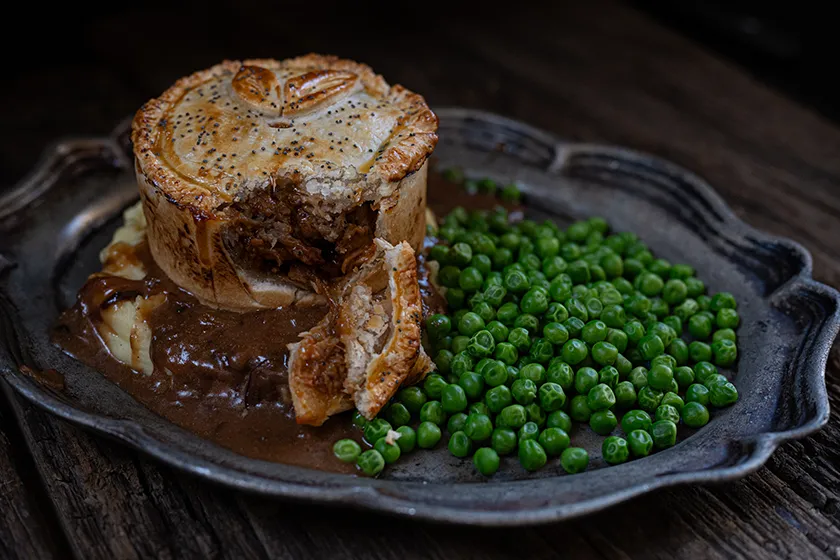
Venison & Stout Meat Pie
Ingredients
For the Filling:
- 2 lbs venison, cut into 1-inch cubes
- 2 tbsp oil (bacon fat or butter works great)
- 1 large onion, diced
- 2 carrots, diced
- 2 celery stalks, diced
- 3 cloves garlic, minced
- 1 cup mushrooms, sliced
- 2 tbsp tomato paste
- 2 tbsp flour (or cornstarch for gluten-free)
- 1 ½ cups stout beer (such as Guinness)
- 1 cup beef or venison stock
- 1 tbsp Worcestershire sauce
- 1 tbsp Dijon mustard
- 1 tsp fresh thyme (or ½ tsp dried)
- 1 tsp fresh rosemary, chopped
- 1 tsp smoked paprika
- Salt & black pepper, to taste
- 1 cup frozen peas (optional)
For the Pie Crust:
- 2 ½ cups all-purpose flour
- 1 tsp salt
- 1 cup cold butter, cubed
- 6-8 tbsp ice water
- 1 egg (for egg wash)
Instructions
Step 1: Prepare the Venison Filling
- Heat oil in a large Dutch oven over medium-high heat. Season venison with salt and black pepper, then sear until browned on all sides. Remove and set aside.
- In the same pot, sauté onion, carrots, celery, and mushrooms until softened (about 5 minutes). Add garlic and cook for 1 more minute.
- Stir in tomato paste and flour, cooking for 2 minutes to remove raw flour taste.
- Pour in the stout beer, scraping up any browned bits from the bottom.
- Add venison back to the pot along with beef stock, Worcestershire sauce, mustard, thyme, rosemary, and smoked paprika.
- Bring to a simmer, cover, and cook for 1 ½ to 2 hours until the venison is fork tender. If the sauce is too thin, let it simmer uncovered for 10-15 minutes until thickened.
- Remove from heat and let the filling cool while you prepare the crust.
Step 2: Make the Pie Crust
- In a large bowl, whisk together flour and salt.
- Cut in the butter using a pastry cutter (or your hands) until the mixture resembles coarse crumbs.
- Gradually add ice water, one tablespoon at a time, until the dough comes together. Do not overwork.
- Divide the dough into two portions, wrap in plastic wrap, and chill for 30 minutes.
Step 3: Assemble & Bake
- Preheat oven to 400°F
- Roll out one dough portion on a floured surface and fit it into a 9-inch pie dish. Trim excess. Or 4-inch spring form pans
- Fill with the venison mixture.
- Roll out the second dough portion and place it over the top. Seal the edges and cut a few slits for steam to escape.
- Brush the top with beaten egg for a golden crust.
- Bake for 30-35 minutes, until the crust is golden brown.
- Let it rest for 10 minutes before serving.
- Serve with mashed potatoes and Peas for balance.
- Pair with a stout beer or a bold red wine like Cabernet Sauvignon.
Check out more From Field to Plate on social media: Facebook/Instagram/YouTube/X